
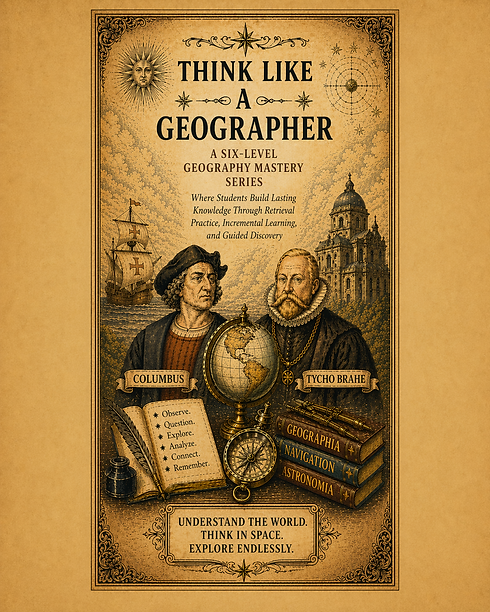
Geography Mastery Series: A Six-Level Series Built on Spaced Repetition, Retrieval Practice, and Student-Driven Exploration (Grades 3-12)
This six-course geography series is designed to deliver both strong academic results and an engaging learning experience. Spanning six sequential 12-week courses, the program builds knowledge and skills step-by-step through intentional incremental learning, ensuring students develop a deep and lasting understanding of the world.
At the heart of the program is a research-based approach that combines short, focused direct instruction with student-driven exploration. Each week begins with a clear introduction to key geographic concepts, vocabulary, and context. Students then apply what they’ve learned through structured, atlas-guided inquiry, allowing them to actively explore and interpret geographic information rather than passively receive it.
The course design intentionally incorporates spaced repetition and retrieval practice—two of the most effective strategies for long-term retention. Students revisit and apply knowledge over time, strengthening memory while continuously building new skills. This consistent cycle of practice and application supports meaningful skill-building and helps students gain confidence in their ability to work independently.
Unlike traditional programs that rely on memorization or busywork, every activity in this series has a clear purpose. Students develop the ability to analyze maps, recognize patterns, and make connections across regions and topics. As they progress through the six courses, they move from foundational knowledge to more advanced geographic thinking, gaining both breadth and depth of understanding.
By the end of the series, students are not only familiar with world geography—they have developed the tools to think critically, learn efficiently, and approach new information with confidence.
Beginning A
Format: One 75-minute class session once a week for twelve weeks during Autumn Session or Spring Session

Students are introduced to the foundations of world geography through maps, continents, oceans, and essential spatial concepts. Using a consistent world atlas, lessons combine short direct instruction with Socratic discussion and student-driven exploration, helping students build confidence, curiosity, and strong geographic habits from the start. Students begin working with core ideas such as latitude and longitude and the Tropics.
Parents will notice growing confidence, improved map-reading skills, and increased curiosity about the world.
Most students memorize maps and forget them—this course helps them actually understand how the world is organized from the start. Through guided exploration and discussion, students build skills that stick and confidence that grows immediately.
Beginning B

Students deepen their understanding of physical and political geography while continuing to build atlas fluency. Through guided Socratic dialogue and structured exploration, they begin connecting locations and recognizing basic geographic patterns across regions. Key concepts include the Continental Divide and map scale.
Parents will notice stronger recall, better spatial awareness, and a clearer ability to explain “where things are” and why they matter.
This is where geography starts to click—students move beyond “where” to understanding patterns and connections. With consistent atlas use and discussion-based learning, knowledge becomes easier to recall and apply.
Prerequisite: Beginning A
Intermediate A
Students move from identification to analysis, exploring how geography influences climate, culture, and human activity. Using the same world atlas, they engage in Socratic discussion and inquiry-based exploration, strengthening retrieval, reasoning, and the ability to explain geographic relationships. Topics include sovereignty and tributary systems.
Parents will notice deeper understanding, more thoughtful answers, and the ability to make connections across regions and ideas.
Students stop guessing and start explaining—this course develops real geographic reasoning. Through Socratic discussion and retrieval-based learning, they begin connecting geography to how the world actually works.
Prerequisites: Beginning A, Beginning B
Intermediate B

Students expand their ability to think independently by examining more complex regional and global systems. Through continued Socratic dialogue and student-driven exploration, they apply prior knowledge to new contexts, refining their analytical skills and geographic reasoning. Concepts such as isthmuses and climate patterns are explored in depth.
Parents will notice increased independence, stronger critical thinking, and more confidence in tackling unfamiliar material.
This is where students become independent thinkers, not just learners. They apply what they know to new situations, building confidence and analytical skills that transfer beyond geography.
Prerequisites: Beginning A, Beginning B, Intermediate A
Advanced A

Students engage in higher-level geographic thinking, analyzing interactions between physical landscapes, human systems, and global processes. Using the shared atlas, they participate in rich Socratic discussions and independent exploration, synthesizing knowledge across regions and themes. Topics include archipelagos and the equinox.
Parents will notice sophisticated thinking, clearer communication, and the ability to analyze rather than simply recall information.
Students move into true analysis, examining how physical and human systems interact across the globe. This course challenges them to think deeply, discuss thoughtfully, and connect ideas at a high level.
Prerequisites: Beginning A, Beginning B, Intermediate A, Intermediate B
Advanced B

In this culminating course, students demonstrate a high school–level understanding of world geography. Through advanced Socratic discussion and student-led inquiry using the same atlas, they analyze global patterns, evaluate relationships, and think critically and independently about the world. Final topics include the solstice and topography.
Parents will notice maturity in thinking, strong retention of knowledge, and the ability to approach complex topics with confidence and independence.
This final course transforms knowledge into mastery, giving students a high school–level understanding of world geography. They leave not just knowing the world—but able to think critically about it.
Prerequisites: Beginning A, Beginning B, Intermediate A, Intermediate B, Advanced A